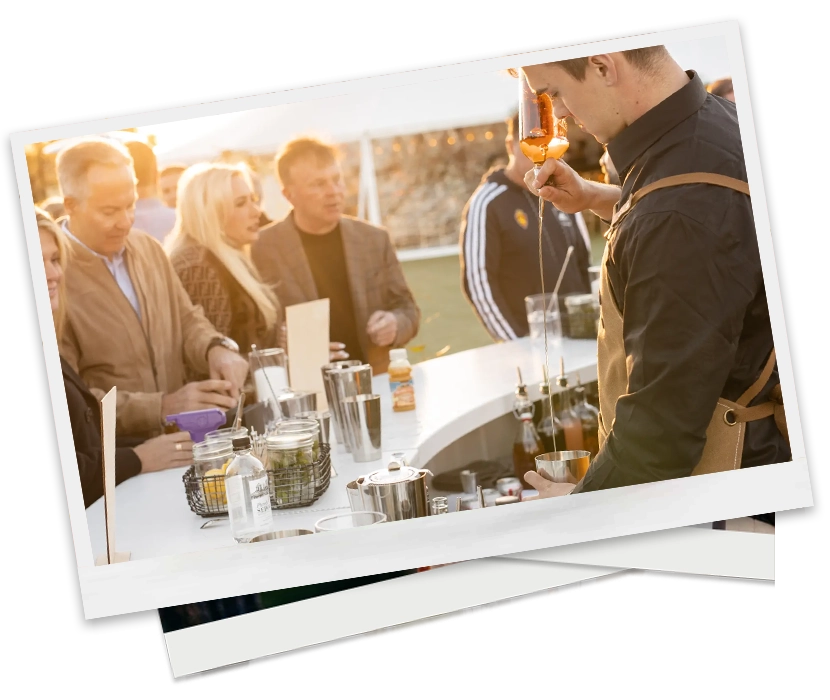
Arizona gives us a lot of reasons to love outdoor events.
Desert sunsets. Mountain views. Courtyards. Rooftops. Resort lawns. Backyards that look like they belong in a magazine.
But if you have planned an event here, you also know Arizona weather has ... well opinions.
A beautiful outdoor beverage setup in March is a COMPLETELY different conversation than that same setup in July. Even indoor events come with their own logistical questions depending on the venue, guest count, service style, and what you are actually trying to serve.
So when you are deciding between indoor and outdoor beverage service for an Arizona event, the answer usually is not simply, “Which one looks better?”
It is: Which setup will give your guests the best experience once we factor in weather, service speed, equipment, layout, and the actual beverage concept?
Here is what WE look at.
There is a reason planners love outdoor bars and beverage stations.
They naturally become part of the event experience. Guests can grab a cocktail while watching the sunset, stop at an espresso cart during a morning conference break, or gather around a specialty beverage station without feeling like they are leaving the action.
But Arizona requires a little more planning.
Everyone immediately thinks about summer heat, and yes, summer is absolutely the biggest consideration.
Bartenders and baristas are working around ice, dairy, fresh fruit, syrups, coffee equipment, garnishes, glassware, and sometimes electronics. Those things usually react to 110-degree temperatures the same way your guests do, not well!
Shade is one of the biggest factors in deciding whether an outdoor beverage setup will actually work in Arizona.
In the summer, full shade for the entire event is usually a must, and even then, the heat can still make outdoor beverage service difficult depending on the setup, equipment, menu, and length of service. Direct sun in June, July, or August is a no-go for most beverage stations.
Spring and fall are much more manageable, but shade is still usually preferable, especially for afternoon events. Arizona sun can feel intense even when the air temperature looks reasonable on paper, and a bar sitting in direct sunlight can heat up quickly.
Keeping the setup shaded helps protect ice, ingredients, equipment, garnishes, and overall drink quality while also making service much more comfortable and efficient. In Arizona, where the sun is hitting the bar often matters just as much if not more as the temperature itself.
Arizona has a very special talent for turning an impressive amount of ice into water.
Outdoor cocktail service, iced coffee, mocktails, dirty sodas, lemonade stations, and other cold beverage experiences may require substantially more ice than an indoor event.
That needs to be considered before the event starts, not halfway through cocktail hour.
Access also matters. If the bar is sitting on the far side of a resort lawn with no nearby service entrance, getting backup ice is a very different situation than working inside a ballroom with a catering kitchen twenty feet away.
These are the little logistics guests never see when an event is planned well.
Arizona event planners spend a lot of time talking about heat, but wind deserves a spot in the conversation too.
Napkins move. Menus move. Lightweight garnishes move. Cups move. Décor moves.
Suddenly the adorable little beverage display you saw on Pinterest is trying to relocate itself across the venue.
Outdoor beverage stations sometimes need weighted signage, adjusted décor, sturdier serving pieces, different garnish storage, or a slightly simplified setup depending on the forecast.
Again, none of this means you should avoid an outdoor setup. It simply means your vendor should be thinking about more than what the bar looks like.
Indoor events give beverage vendors something we really appreciate: predictability.
Temperature is controlled. Equipment is protected. Ice lasts longer. Wind is not launching cocktail napkins into another zip code.
For certain beverage experiences, indoor service may simply make more sense.
Mobile espresso service can absolutely work outdoors, but coffee equipment has specific power requirements and generally performs best when it is protected from extreme temperatures and weather.
Indoor conferences, weddings, corporate events, morning meetings, and holiday parties are especially well suited for espresso bars because the setup can often be positioned near power while still becoming an interactive guest experience.
And yes, location still matters.
Putting the coffee bar in a forgotten hallway because there happens to be an outlet nearby is not necessarily the answer.
The best setup balances operational requirements with guest flow.
If you are planning an activation involving custom image printing, edible garnishes, specialty presentation pieces, multiple syrups, branded elements, or a more detailed cocktail program, indoor environments may give you more control.
That can allow for a more intricate setup without constantly working around sun, wind, melting ice, or temperature-sensitive ingredients.
It also gives planners more flexibility with displays, menus, signage, florals, and other visual elements around the beverage station.
One of the biggest mistakes we see is choosing the bar location based entirely on where it looks good.
A beautiful bar in the wrong location can create a line across a walkway, block a catering entrance, pull guests away from the main event, or become practically invisible.
Indoor or outdoor, we always want to think about how guests will actually move.
Where are they entering?
Where are they gathering?
Where is food being served?
Where are speeches happening?
Where is the dance floor?
Where are people naturally going to look for a drink?
At larger Arizona events, multiple beverage stations may make significantly more sense than one giant bar.
Two strategically placed service points can sometimes move guests much faster than one highly decorated bar everyone has to find.
This is particularly important for specialty beverage experiences.
Traditional cocktail bars can often operate fairly independently, but espresso bars, frozen beverage machines, some branded beverage activations, and other specialty setups may need reliable power.
And “there is an outlet nearby” does not always mean we are good to go.
We may need to know the circuit capacity, how far the outlet is from the setup, whether other vendors are using the same power source, and whether extension cords can safely run through the space.
This is one reason venue walk-throughs and detailed conversations with your beverage vendor can save a lot of headaches later.
If you are planning an outdoor beverage setup, the month of your event matters enormously.
This is Arizona event season for a reason.
Outdoor beverage service is usually very comfortable, especially during morning and late afternoon/evening events.
That said, winter nights can become colder than visitors expect, and late fall and spring afternoons can still be hot.
A November event at 2 p.m. and a November event at 7 p.m. may require completely different considerations.
These are transition months.
Outdoor events can still be fantastic, but shade, event timing, and temperature become much more important.
Early morning or evening events are generally much easier than middle-of-the-afternoon setups.
Outdoor events are possible.
But they need to be intentional.
Cooling, shade, indoor backup space, service duration, menu selection, staff safety, product temperature, and equipment requirements all need to be considered carefully.
Sometimes the best answer is an indoor beverage station with an outdoor event.
Guests can still enjoy the patio or lawn while beverages are prepared inside in a controlled environment.
Sometimes the drink itself tells us where the bar should go.
A simple wine and beer station is very different operationally from a full espresso bar.
A branded mocktail activation with detailed garnishes is different from a grab-and-go canned beverage station.
When we help clients think through service, we are looking at more than the location.
We are thinking about:
Sometimes simplifying the menu slightly can make an outdoor setup dramatically easier without sacrificing the guest experience.
Other times, moving the beverage station fifteen feet inside completely opens up what is possible.
Honestly, these are some of our favorites.
Arizona venues frequently have ballrooms opening onto patios, courtyards connected to indoor reception spaces, or conference areas that flow into outdoor networking spaces.
That gives us options.
Cocktail hour might happen outside while espresso is served indoors later in the evening.
A welcome beverage station might sit outside near registration while the primary bar operates inside.
A branded activation could sit directly between the two spaces and naturally catch guests moving in both directions.
Instead of thinking, “Does the bar need to be inside or outside?” it can be more helpful to ask:
Where does this beverage experience make the most sense within the flow of the event?
That question usually leads to a much better answer.
Guests should not be wondering why the drink line is taking forever.
They should not see melting garnishes or cords running awkwardly through walkways.
They should simply walk up, get a great drink, enjoy the experience, and move on with their event.
That ease usually comes from a surprising amount of planning behind the scenes.
Indoor and outdoor beverage service can both be fantastic for Arizona events. Neither one is automatically better.
The right choice depends on the season, venue, beverage menu, equipment, guest flow, event timing, and what you want the beverage experience to accomplish.
And when those pieces work together?
That is when the bar stops being just the place guests grab a drink and starts becoming part of the event itself.
Craft Your Event